
Buying a home in Richmond is a big financial step, and one of the most common questions I hear from buyers is:
“How much money do I actually need to buy a home?”
The answer isn't quite as simple as looking at the down payment.
You'll need money for your down payment, closing costs, Property Transfer Tax, legal fees, inspections and other expenses that come with purchasing a home.
And with Richmond home prices varying significantly between condos, townhomes and detached houses, the amount you'll need can look very different depending on what you're buying.
Let's break it down.
First, How Much Do Homes Cost in Richmond?
Richmond offers everything from smaller condos to luxury detached homes, so there isn't one price that represents the entire market.
As of July 2026, Greater Vancouver REALTORS® reported the benchmark price of a Richmond apartment at approximately $639,700, while the overall residential benchmark price in Richmond was approximately $1.102 million.
Detached homes are considerably more expensive. For perspective, the benchmark price for a Richmond detached home was approximately $1.911 million in July 2026.
Remember that a benchmark price isn't necessarily what your home will cost. There are properties available above and below these numbers depending on the neighbourhood, age, size, condition and type of home.
But they give us a useful starting point.
How Much Down Payment Do You Need?
This is where many buyers are surprised.
You don't necessarily need a 20% down payment to buy a home.
For homes eligible for an insured mortgage, Canada's minimum down payment requirements are:
5% on the first $500,000
10% on the portion between $500,000 and $1.5 million
Homes priced at $1.5 million or more generally require at least 20% down for a conventional mortgage.
The federal government increased the insured-mortgage price cap from $1 million to $1.5 million in December 2024, making it possible for more buyers in higher-priced markets such as Richmond to purchase with less than 20% down.
So what does that actually look like?
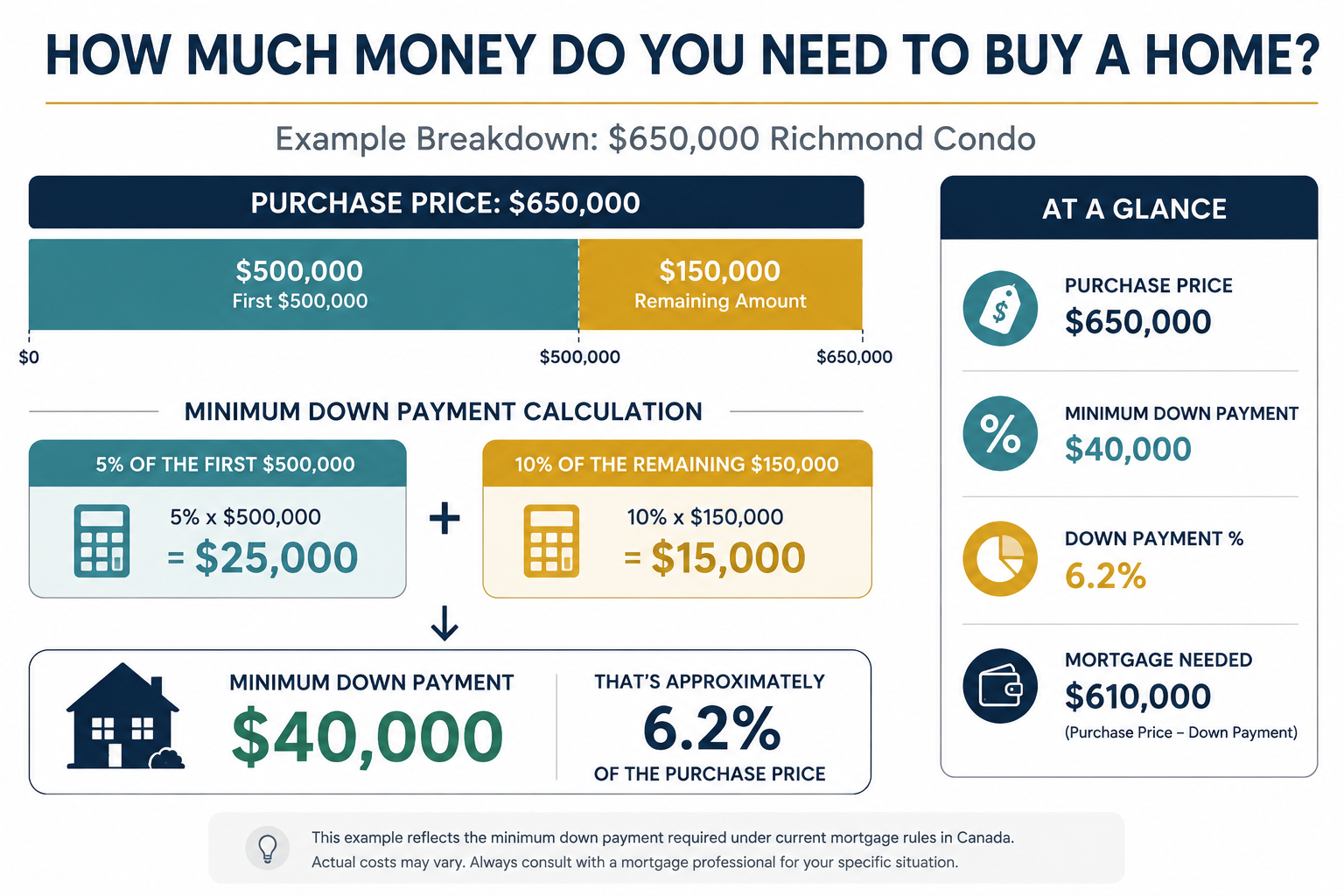
$650,000 Richmond Condo
Minimum down payment:
5% of the first $500,000 = $25,000
10% of the remaining $150,000 = $15,000
Minimum down payment: $40,000
That's approximately 6.2% of the purchase price.
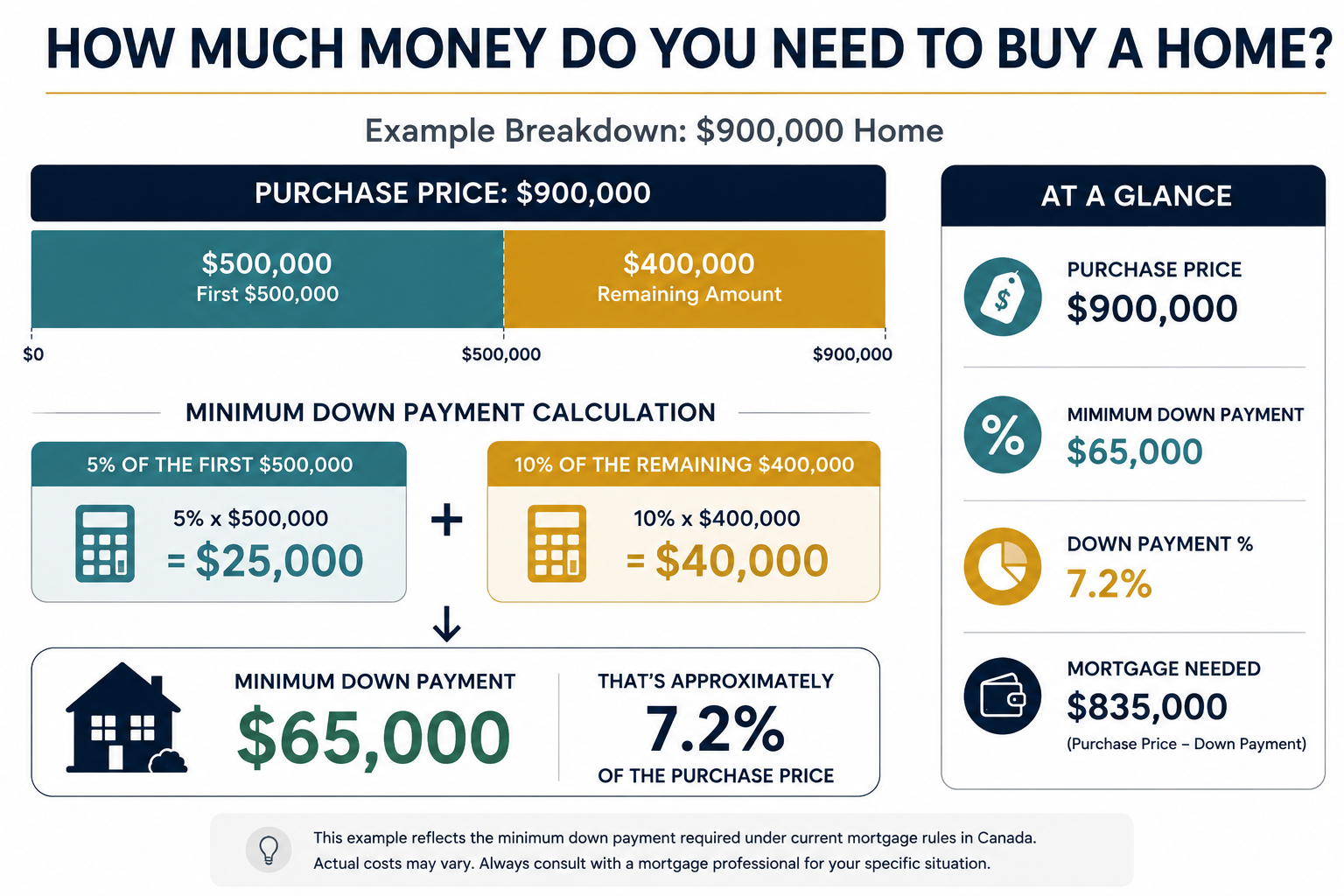
$900,000 Home
5% of the first $500,000 = $25,000
10% of the remaining $400,000 = $40,000
Minimum down payment: $65,000
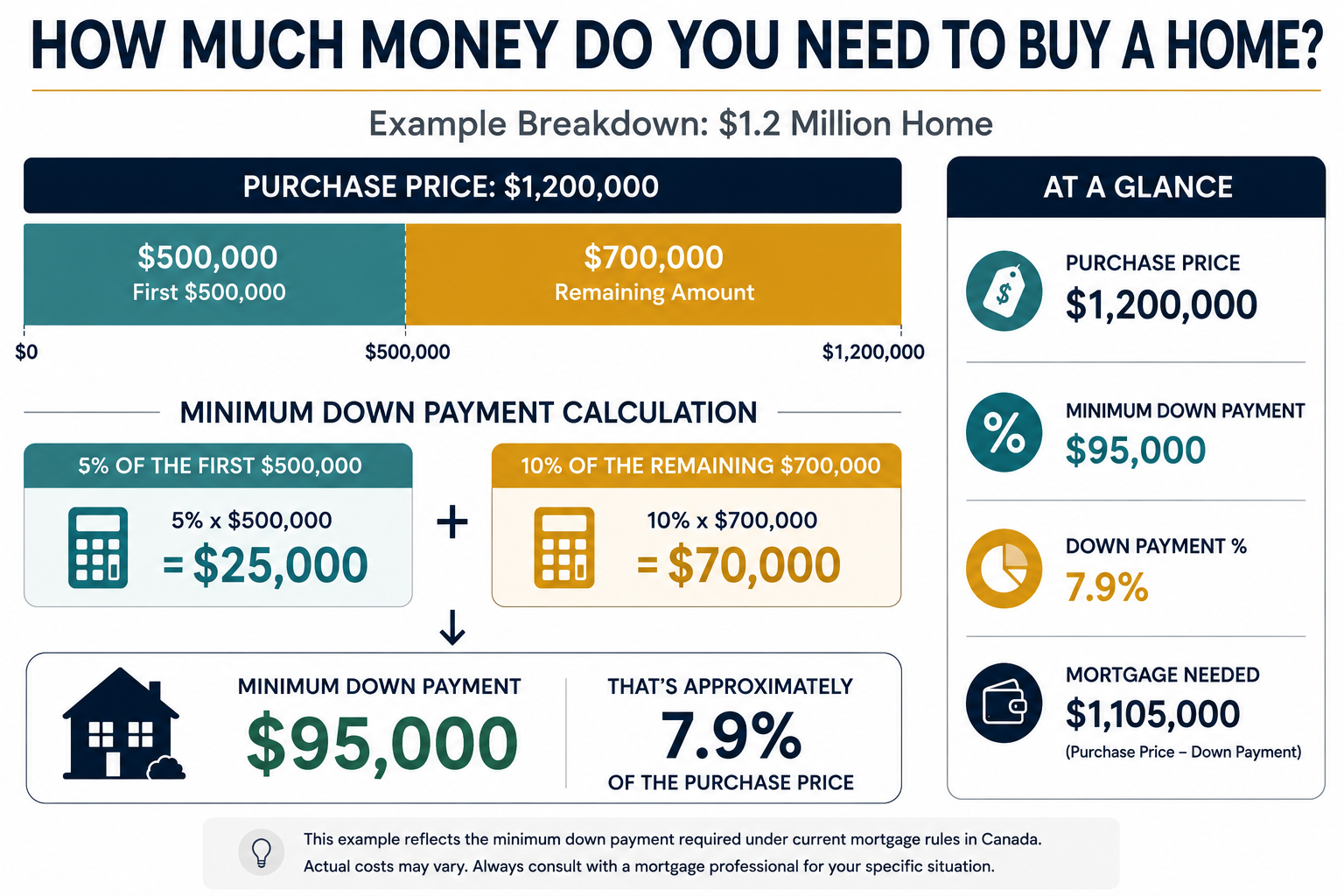
$1.2 Million Home
5% of the first $500,000 = $25,000
10% of the remaining $700,000 = $70,000
Minimum down payment: $95,000
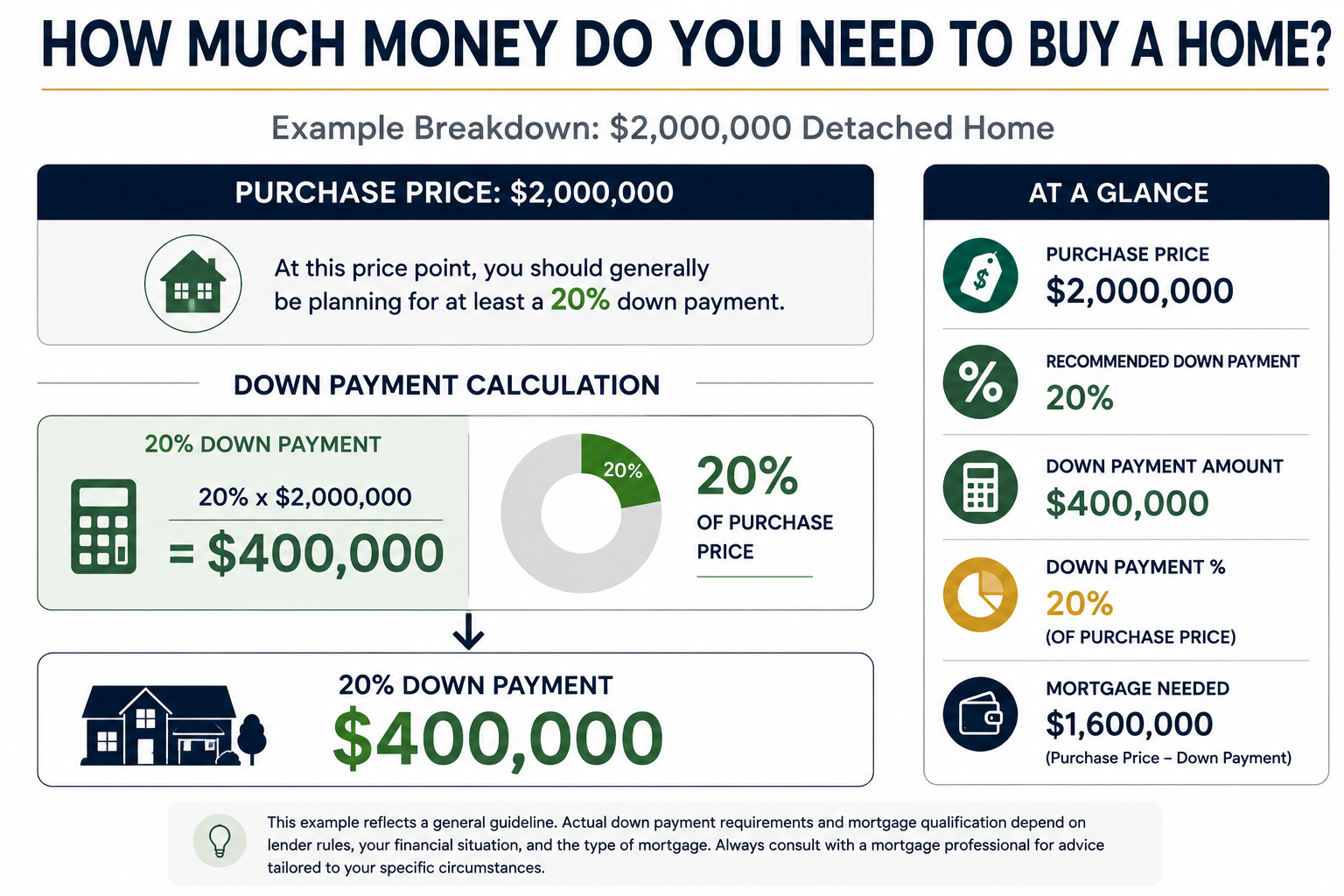
$2 Million Detached Home
At this price point, you should generally be planning for at least a 20% down payment.
20% down payment: $400,000
Of course, qualifying for the mortgage is another matter. Just because you have the minimum down payment doesn't necessarily mean a lender will approve you for the remaining mortgage.
Your income, existing debts, credit history, interest rates and other factors will all affect how much you can borrow.
Don't Forget About Property Transfer Tax
This is one of the biggest expenses buyers sometimes forget to budget for.
When you purchase property in BC, you generally pay Property Transfer Tax (PTT).
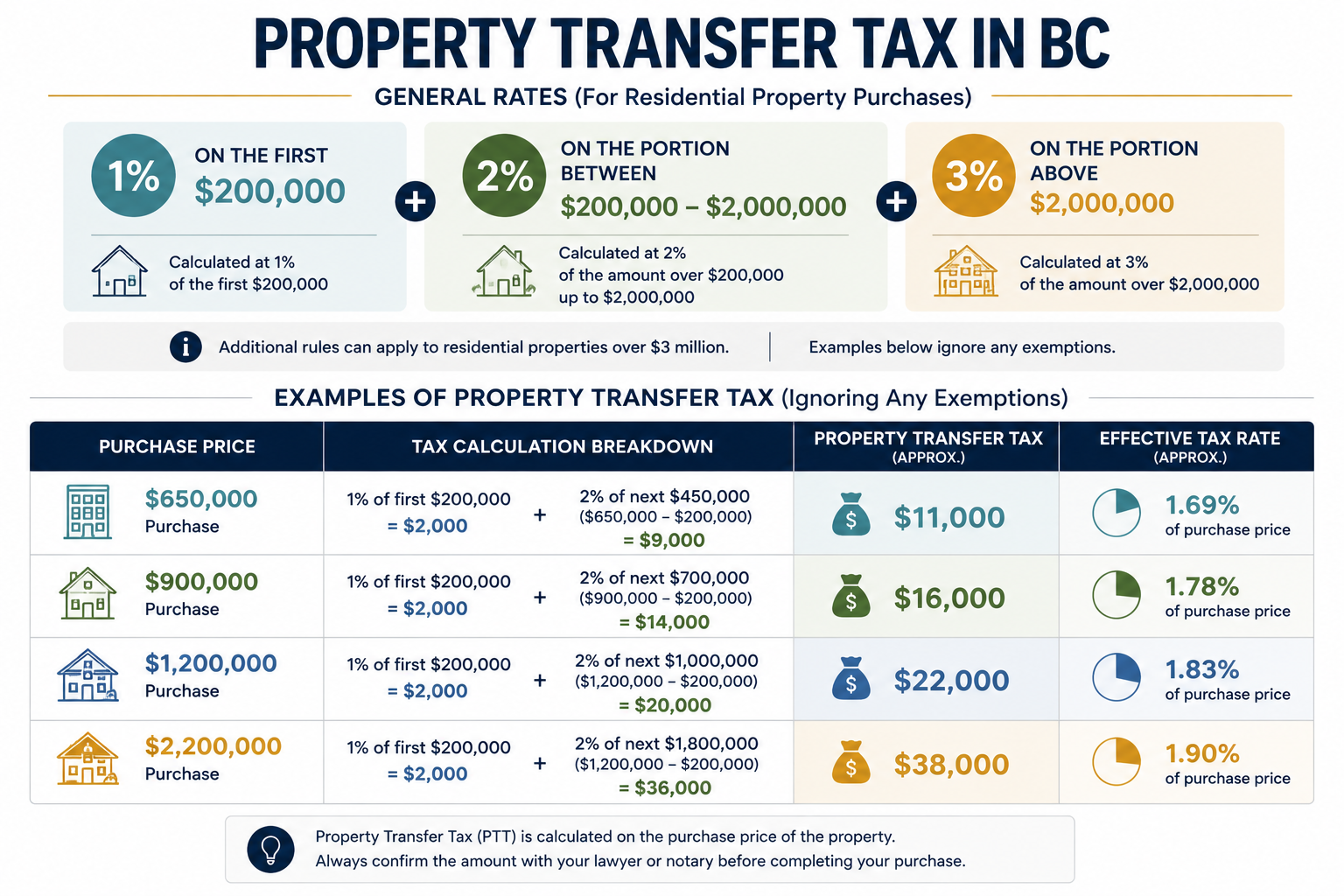
The general rates are:
1% on the first $200,000
2% on the portion between $200,000 and $2 million
3% on the portion above $2 million
Additional rules can apply to residential properties over $3 million.
For example, ignoring any exemptions:
$650,000 purchase: approximately $11,000
$900,000 purchase: approximately $16,000
$1.2 million purchase: approximately $22,000
$2 million purchase: approximately $38,000
That's money you'll need in addition to your down payment.
Are You a First-Time Home Buyer?
If you're buying your first home, you may be able to reduce some of these costs.
Under BC's First Time Home Buyers' Program, qualifying buyers purchasing a property with a fair market value of $835,000 or less can receive an exemption from Property Transfer Tax on the first $500,000 of the home's value.
A partial exemption is available for qualifying homes valued between $835,000 and $860,000.
That can make a meaningful difference for someone purchasing a Richmond condo.
There are eligibility requirements, so don't assume that simply being a first-time buyer automatically qualifies you for every exemption. Your lawyer, notary or mortgage professional can help determine what applies to your particular purchase.
What About Mortgage Insurance?
If you're purchasing an eligible home with less than 20% down, you'll generally need mortgage default insurance.
One important distinction is that the insurance premium is typically added to your mortgage rather than requiring you to come up with the entire premium in cash at closing.
However, it still increases the amount you're borrowing.
This is why it's worth comparing scenarios.
Sometimes putting more money down can significantly reduce your mortgage and insurance costs. Other times, keeping additional cash available for renovations, emergencies or other expenses may make more sense.
There's no one-size-fits-all answer.
Other Closing Costs You Should Budget For
Your down payment and Property Transfer Tax are the big ones, but they're not the only expenses.
Depending on the property and your situation, you may also need to budget for:
Lawyer or notary fees
You'll need someone to handle the legal transfer of the property and mortgage documents.
Home inspection
I always recommend having a professional inspection performed on any property you plan to purchase. It's a relatively inexpensive cost for peace of mind.
Appraisal
Your lender may require an appraisal of the property.
Strata documents
If you're buying a Richmond condo or townhouse, reviewing the strata's financials, minutes, depreciation report and other documents is extremely important.
Property tax adjustments
Depending on when you complete your purchase, you may owe the seller for a portion of property taxes they've already paid.
Moving expenses
Movers, storage, furniture and all the little expenses associated with moving can add up quickly.
Immediate repairs or renovations
Even if the home is move-in ready, it's a good idea to have some money left over after completion.
So, How Much Cash Should You Actually Have?
Let's use a hypothetical $650,000 Richmond condo.
Your minimum down payment would be approximately:
$40,000
Property Transfer Tax would normally be approximately:
$11,000
Then you'll need to account for legal fees, inspection costs, adjustments and other closing expenses.
So you shouldn't approach a $650,000 purchase thinking:
"I have $40,000, so I'm ready to buy."
I'd much rather see buyers go into a purchase with some breathing room.
And if you're a qualifying first-time home buyer, your Property Transfer Tax could potentially be substantially reduced, which changes the calculation.
Having a Down Payment Doesn't Necessarily Mean You Can Afford the Home
This is probably the most important point.
There are really two different questions:
1. How much cash do I need to buy the home?
and
2. How expensive of a home can I actually afford?
They're not the same thing.
You might have $100,000 sitting in the bank for a down payment, but your income may not qualify you for a $1.2 million mortgage.
On the other hand, someone with a high household income might easily qualify for the mortgage but hasn't saved enough for the down payment and closing costs.
That's why I recommend talking to a mortgage professional before you seriously start looking at homes.
Knowing your actual purchasing power makes the entire home search much easier.
Don't Spend Every Dollar on Your Down Payment
Just because you can put every dollar you have toward your home doesn't necessarily mean you should.
After buying, you may suddenly need money for:
Furniture
Appliances
Repairs
Renovations
Strata fees
Moving
Property taxes
Home insurance
Unexpected expenses
Homeownership is much more enjoyable when an unexpected repair doesn't completely drain your bank account.
I generally encourage buyers to think about their total financial picture, rather than simply trying to maximize their purchase price.
Start With a Budget, Not a Listing
It's easy to start browsing listings online and fall in love with a home before knowing whether the numbers work.
I recommend doing it the other way around.
Figure out:
How much cash do you have available?
How much do you want to put down?
What mortgage can you comfortably afford each month?
How much money do you want left over after the purchase?
Once we know those numbers, we can start looking at what your budget can realistically buy in Richmond.
And you might be surprised by the options available.
Thinking About Buying a Home in Richmond?
Whether you're looking for your first Richmond condo, moving into a townhouse, or searching for a detached family home, understanding the numbers before you begin can make the buying process much less stressful.
I've helped buyers navigate Richmond's real estate market through different neighbourhoods, property types and price ranges, and I'm always happy to help you understand what your budget might realistically get you.
If you're thinking about buying a home in Richmond, let's chat.
We can talk about your budget, what you're looking for, and which Richmond neighbourhoods and properties may be the best fit for you.

 The data relating to real estate on this website comes in part from the MLS® Reciprocity program of either the Greater Vancouver REALTORS® (GVR), the Fraser Valley Real Estate Board (FVREB) or the Chilliwack and District Real Estate Board (CADREB). Real estate listings held by participating real estate firms are marked with the MLS® logo and detailed information about the listing includes the name of the listing agent. This representation is based in whole or part on data generated by either the GVR, the FVREB or the CADREB which assumes no responsibility for its accuracy. The materials contained on this page may not be reproduced without the express written consent of either the GVR, the FVREB or the CADREB.